S&P 500 hits new All Time High


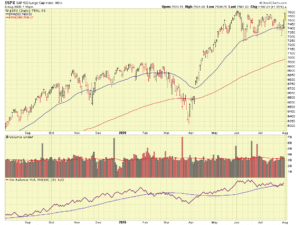
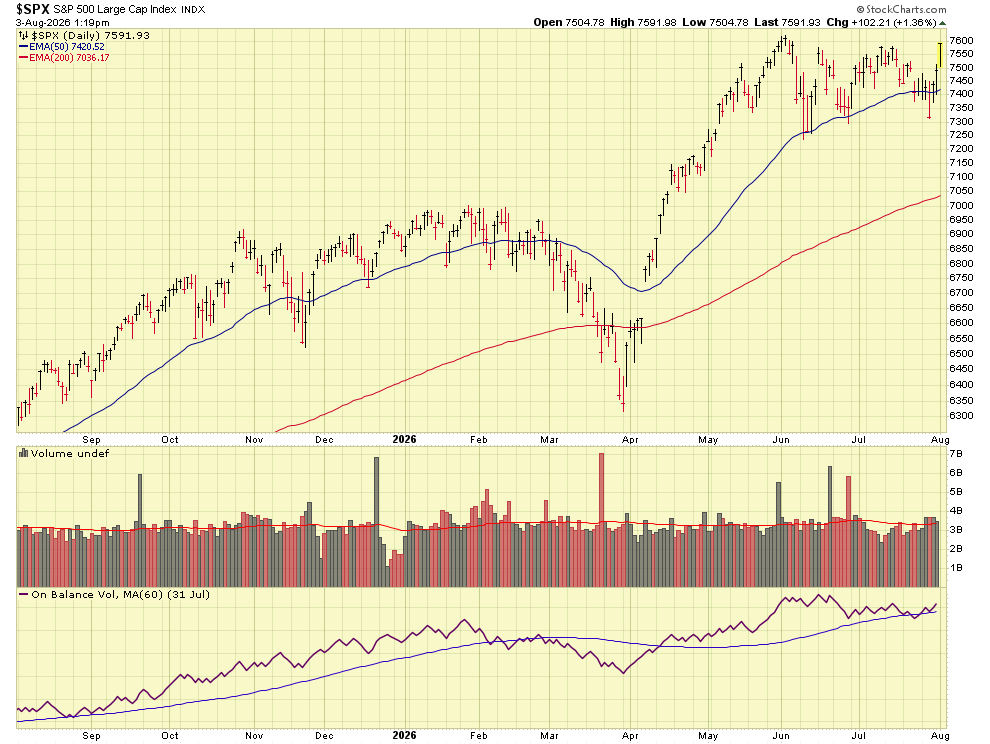
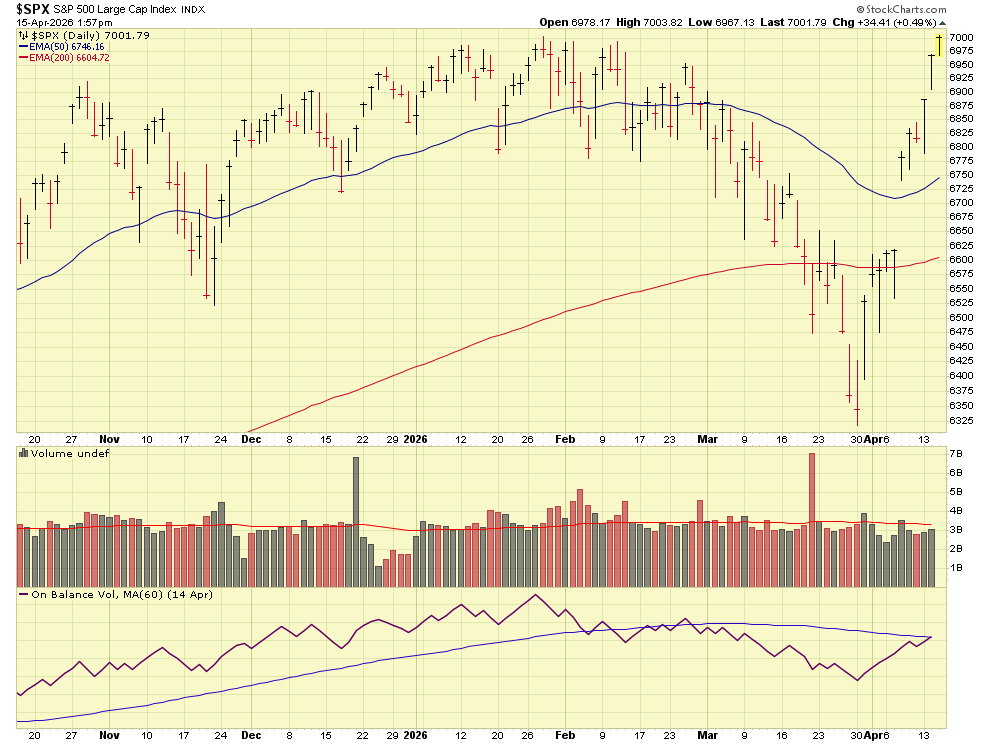
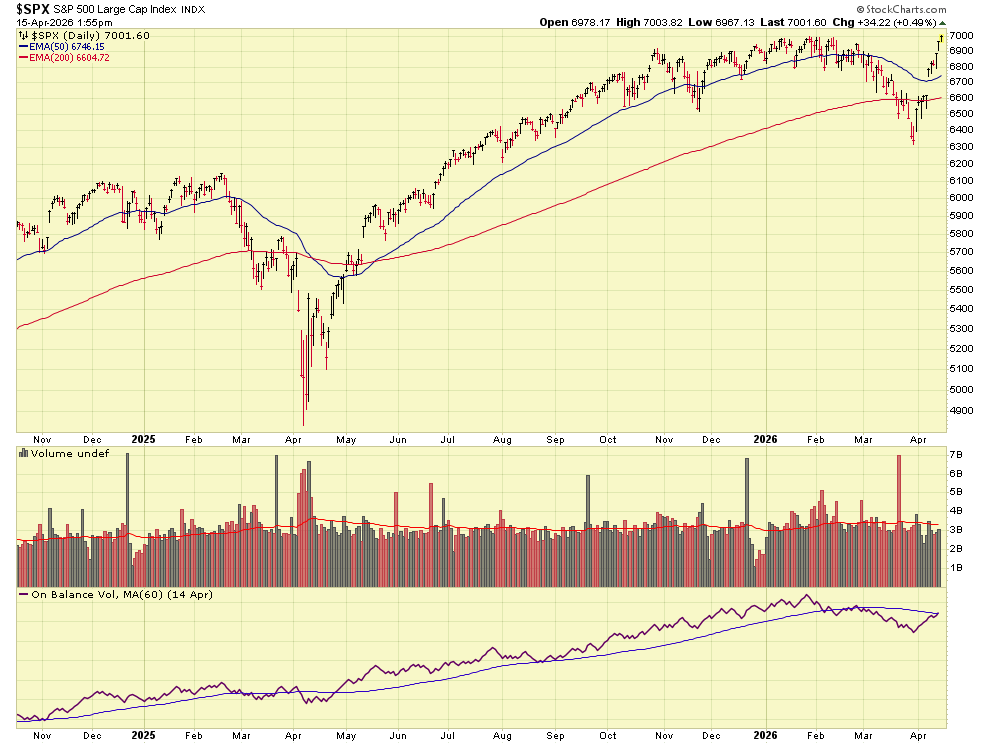
Well hello folks, happy belated “Spring” – hope everyone is doing well.   For those not living in a cave, we know the market has witnessed some turbulence in light of the Iran/US conflict (or whatever we are calling it, I will stay apolitical as much as possible…).    However today, 04/15/26, the S&P 500 hit a new all-time high, hitting 7008.45.  Let’s take a look at the charts:

Before I expand on today’s action, allow me to gently remind the audience that I do not trade my TSP.   Contrary to belief that I am a “market timer” and “chasing peaks and bottoms” this is not completely true.  I indeed believe in asset allocation and also support the concept that one should be in the best performing assets/funds.   Based on my personal assessment of the markets, and my own risk tolerance, I indeed may switch funds.   This in many circles, to include Vanguard, is considered portfolio re-balancing.   To be fair, earlier in my TSP career my moves were more frequent.  The market, arguably was a different animal to some extent also.   Different people may call it different things, and that is fine.  There are 10,000 mutual funds out there, I am sure one exists for everyone.   Moving forward, lets talk about the Iran conflict and why I consider it a Black Swan event.

A “Black Swan” is an event is so rare and outside the realm of expectations that it is unpredictable. Second, the extreme effects of the event can be beneficial or catastrophic, although usually only the black swans with catastrophic effects get attention.   Sept 11, 2001, Boston Marathon bombing, COVID, are examples of Black Swans.   You cannot (not without inside information) trade these.   You cannot predict these.  You just have to roll up the windows, seek shelter, and hope the storm passes quickly.   Going off memory, but I believe in every single instance, I remained fully invested in stock funds.  Even in COVID year of 2020, I remained in stock funds.

I get more concerned with slow, measured, “unwinding of positions.”  The 2007-2009 financial crisis (note:  I got many readers “out” of stocks before this crisis hit, one of my most famous “calls” in the existence of this website) is one example.   Numerous people were happy to “re-allocate” into the G-Fund in late 2007.    When an index “slowly breaks down” that is much more concerning than Black Swans.   Black Swans trigger emotion, which results (often) in bad decisions.  Slow unwinding represents careful forethought.   Smart money, the BlackRocks, Morgan Stanleys, Bridgewater Associates, Ray Dalio, etc all are pretty smart, with pretty smart software and people.   When they start unwinding, I want to know why.

Starting to rant, my apologies.  Bottom Line is that my TSP remains 50% S-Fund and 50% I-Fund (indeed the I-fund has left a painful sting recently…).

If this conflict with Iran remains ongoing, further economic damage could indeed spread and contaminate things.  I don’t see that, yet.  Regarding the 2007-2009 financial crisis, late 2007 the market started to realize that the problem was inside the system.  It then sold off with the most severe damage occurring in 2008.  Today’s conflict is serious, but markets are still behaving as though the problem is outside the system unless it spreads into oil, inflation, credit, or funding stress. That is the critical dividing line.  Which may result in some decisions to be made in regards to the TSP.

Until then, thank you for reading and I will try to get more updates out, more than on a “quarterly basis.”   I am also evaluating other publishing platforms and methods, as this medium has occasionally flagged some of my charts and graphics as virus-risk and not accepted them.  Furthermore, in 2026 most people read this via a mobile device, and I want to ensure the accessibility of my content is aligned with current practices, versus “Windows PC Desktop” focused.

Stay tuned for that, I am retired and working on these things at a leisurely retired-guy pace.

Also, a shout-out to my colleagues Chris Barfield (US Marshals, retired) of Barfield Financial and Dan Jamison (FBI, retired) of the FERS Guide .   If you need additional perspective on the FERS and TSP please take a look at their excellent information and resources.   Both are CPAs with formal training in the accounting space, I encourage everyone take a look at their websites.

-Bill Pritchard


Great start to 2026

Howdy folks

Bottom Line Up Front:  My TSP is now 50% S-Fund and 50% I-Fund.   This allows “exposure” to both international stocks, many of which will benefit from international AI manufacturing, and the small cap stocks which I anticipate will do well in 2026.

OK, lets get started…..Hope you’re all doing well out there and staying warm as we kick off the new year in earnest. January wrapped up with a solid start for TSP participants—all the core funds posted positive returns, giving everyone a nice boost right out of the gate for 2026. That’s the kind of momentum we like to see early in the year, especially after the strong finish to 2025 where the international side really carried the load.

Let’s dive right into what happened in January. The markets opened the year on a positive note overall, with stocks showing resilience despite some choppiness toward the end of the month. The S&P 500, which the C-Fund closely follows in its performance, ended up about 1.45% for the month. That put the C-Fund right at +1.45% for January, and the same for year-to-date since we’re still early. It’s a modest gain, but steady—markets spent parts of the month hitting new highs before pulling back a bit on rotation out of some big tech names and digestion of earnings reports. Still, breadth improved under the surface, and the index held firm overall. For TSP folks in the C-Fund, that’s a reliable step forward, reflecting the ongoing strength in large-cap U.S. companies.

The S-Fund, focused on small- and mid-cap U.S. stocks, did even better at +2.41% for the month. That’s a nice out-performance compared to the large-caps, showing that smaller companies caught a bid as investor attention broadened out a little. Year-to-date matches that at +2.41%. We’ve seen this pattern before where small-caps can lead when sentiment shifts toward more domestic-focused plays, and January gave us a taste of that potential.

Now, the standout performer by far was the I-Fund, up a strong +5.94% in January. International developed markets really delivered, building on the momentum from late last year when the I-Fund led with over 32% for all of 2025. Year-to-date is the same +5.94%, and trailing 12-month numbers are still impressive around 35%.

Overall, TSP returns for January looked like this across the main ones we watch closely:

  • G-Fund: +0.37%
  • C-Fund: +1.45%
  • S-Fund: +2.41%
  • I-Fund: +5.94%

That’s a clean sweep positive, with the international exposure leading the charge. Not every month starts this way, but when it does, it’s a great foundation—especially for those of you who stayed the course through any late-2025 volatility.

Shifting gears to the outlook for the next 30-90 days—February through April—we’re in a period where patience and steady hands usually pay off. The Federal Reserve met at the end of January and held the federal funds rate steady in the 3.5% to 3.75% range. That was widely expected after the cuts through late 2025, and Chair Powell emphasized data-dependent moves ahead. Markets aren’t pricing in aggressive easing anytime soon—maybe one cut later in the year, possibly summer or beyond, if inflation continues to moderate and growth holds steady without overheating.

Economic data so far this year points to solid activity: job gains continuing at a measured pace, unemployment stabilizing, and consumer spending holding up. Inflation remains somewhat elevated but not runaway. The risk balance looks manageable—no major shocks on the horizon right now, though we’ll watch incoming reports on jobs, CPI, and retail sales closely. Earnings season is ramping up too, with big tech and others reporting, which could drive some volatility but also upside if results beat expectations.

For the TSP funds, this setup suggests continued potential for positive equity moves, especially if broadening continues. The C-Fund and S-Fund could benefit from domestic resilience, while the I-Fund has room if global growth stays supportive. The G-Fund will keep chugging along at its reliable clip, acting as the anchor. Volatility might pick up here and there—markets don’t go straight up—but nothing screams major correction in the near term. Stay diversified, rebalance if needed per your plan, and avoid chasing short-term noise. This is marathon territory, not sprint.

Now, on to other topics of interest to federal employees right now: the partial government shutdown that kicked in at midnight on January 31, 2026, after funding lapsed for several major appropriations bills.

This is a partial shutdown affecting agencies under the remaining unfunded bills, including parts of DHS, DOD (with some exceptions), Labor, HHS (except certain areas), Education, Transportation, HUD, Financial Services, National Security, State Department, and others. Many non-essential functions have paused, and agencies began issuing furlough notices to affected employees over the weekend and into this week. Essential or excepted personnel continue working, though without immediate pay until resolved.

The good news is this one looks short-lived. The Senate passed a package late last week funding most areas (including Defense) through the year, plus a short-term continuing resolution for Homeland Security to allow more negotiation time. House Speaker Johnson has expressed confidence in having the votes to pass and end the lapse quickly—potentially by Tuesday or very soon after the House returns and acts. Lawmakers are aiming to minimize disruption, and historical precedent shows brief lapses like this often wrap up fast when momentum builds.

Importantly, under the Government Employee Fair Treatment Act, furloughed employees are entitled to retroactive pay once funding resumes—no lost income in the end. Back pay is guaranteed for the period affected. Agencies like the IRS have already signaled exemptions or extensions for certain staff to keep operations smooth during tax season. For most feds, this means some inconvenience (possible delayed services, closed offices for non-essential work), but paychecks should catch up fully.

Hang in there if you’re impacted—stay in touch with your agency’s guidance, and this should resolve without turning into a prolonged event. We’ll keep an eye on developments and update as needed.

Wrapping this up, January gave TSP accounts a strong launch into 2026 with gains across the board, led by international strength. The near-term outlook remains constructive with steady rates and solid fundamentals supporting equities, while the G-Fund provides that dependable sleep-at-night fund. On the federal side, the partial shutdown is underway but appears headed for a quick resolution.

This is for informational purposes only and is not investment advice. Past performance does not guarantee future results. Please consult with your own financial advisor or do your own research before making any investment decisions regarding your TSP or other accounts.

Talk to you soon—stay safe and take care

-Bill Pritchard

Merry Christmas – my TSP Allocation remains the same

Hello everybody—

Bottom Line Up Front:  My TSP Allocation remains 50% C-Fund and 50% S-Fund.

Happy Holidays to you and your families.  As we close out 2025, the markets delivered a quiet but positive finish in the holiday-shortened session on December 24. The S&P 500 closed at a fresh record high of 6,932, up about 0.3% on light volume, extending its impressive year-long rally. This “Santa Claus Rally” has been supported by resilient economic data, moderating inflation, and optimism around continued AI-driven growth and a soft landing.

For TSP participants, this strength has shown up across the equity funds. The C Fund, tracking large U.S. companies, has benefited from broad market gains and is up strongly year-to-date. The S Fund, aligned with small- and mid-cap stocks, has shown solid momentum in recent months despite some volatility. The I Fund, focused on international developed markets, has been a standout performer, with strong gains driven by global recovery and earlier currency tailwinds. The G Fund has provided its steady, reliable returns, offering stability for conservative allocations.

Looking back over the past few months, the markets have demonstrated remarkable resilience. After a choppy November with modest gains, December brought renewed buying interest, particularly in technology and growth sectors. The S&P 500 has climbed steadily, with multiple record closes in the final weeks, fueled by better-than-expected corporate earnings, continued AI infrastructure spending, and a Federal Reserve that has eased policy without sparking inflation concerns.

TSP fund performance reflects this positive environment. As of late December, approximate year-to-date returns include the C Fund up around 18-19%, the S Fund up roughly 13-14%, and the I Fund exceeding 25-30% in some periods earlier in the year. The G Fund has delivered consistent, modest gains aligned with short-term Treasury yields.  Indeed the I-Fund outperformed, however my personal “comfort level” kept me out of international stocks this year.   Yes, some gains were missed but remember, we are balancing risk and reward and the ability to sleep at night.  Contrary to what some believe, NO this is not a day-trade-your-TSP site.   I want long term trends as much as the next guy.

As we move into the new year, the outlook for the next 30-90 days remains cautiously positive, supported by several factors. The Federal Reserve’s December rate cut to a 3.5%-3.75% range has continued to provide accommodative conditions, with markets anticipating limited additional easing in early 2026. Inflation remains on a favorable path toward the Fed’s 2% target, and economic indicators suggest moderate growth, driven by consumer spending and business investment, particularly in AI and technology.

For TSP funds, this environment could sustain upside in the C and S Funds if large- and small-cap momentum holds. The I Fund may benefit from ongoing global recovery, though currency moves and trade policy remain variables. The G Fund will likely continue its steady, low-risk returns, serving as a safe harbor amid any short-term uncertainty.  In more times than not, the best performers in the first quarter of a New Year are domestic large cap and small cap stocks, aka C-Fund and S-Fund.

Key events to watch include upcoming inflation reports, corporate earnings seasons, and any policy developments. While risks such as geopolitical tensions or unexpected data shifts persist, the current setup points to equities potentially carrying forward some of late-2025 strength into Q1 2026.

Beyond the markets, federal employees and retirees have faced some significant developments. The lengthy government shutdown, which lasted over 40 days, has now ended with the passage of funding legislation. Agencies are working to restore full operations, process back pay for furloughed and excepted employees, and rescind any related layoffs. This resolution brings relief after a challenging period, though some backlogs and adjustments may take time to clear.   As change (especially during administration changes…) is always constant, it is still-apparent the importance of “having your ducks lined up” for retirement:

– Communications with your HQ retirement / personnel section

– Networking, career fairs, lunch-and-learns, job search activity, resume reviews/prep services

– Financial and benefits awareness (this site, Barfield Financial, The FERS Guide)

-Shocking:  HQ has no “find-you-a-retirement-job” section.  That is on YOU.

On the benefits side, a small pay raise for most federal employees will take effect in early 2026, with ongoing discussions around adjustments for certain groups like law enforcement. Health and retirement planning remain key priorities—review your FEHB options, survivor benefits, and TSP allocations as the year begins.

In summary, 2025 ended on a high note, with strong performance in TSP stock funds and stability from the G Fund. Looking ahead, moderate growth and supportive policy could keep equities positive into early 2026. For federal employees, the shutdown’s end and steady benefits updates provide a solid foundation for the year ahead.

Possible website changes for 2026

In other news, please anticipate some changes to this website for 2026, to include an expansion of topics that I talk about, such as the stock market in general, commentary regarding business related topics, and other stuff.   Being retired, the “world” is much bigger than the C/S/I-Funds, and so is my personal investing.  The format may include a tiered plan, with both free and paid options.  As most know, this site has been free since it began over 10 years ago.  I would need about 100 fingers to count the frequent LinkedIn messages, texts, and folks tracking me down, all conversations that start with “Hey, I am retiring (or not) what do you think about XXXX.”    Furthermore, recent WordPress hosting and server security has flagged some image uploads and posts as virus risks, and I have almost had to become an HTML coder to get some of the quirks ironed out recently.  Time is money, and my “volunteer community service hours” on this site will likely undergo a transition.

Thank you for reading, and please share with anyone who might benefit from this update.

Before you go, please complete this short retirement poll/survey for 2026:

https://poll-maker.com/poll5680726x004745fb-166

Thank you and MERRY CHRISTMAS

-Bill Pritchard

S&P 500 hits new high


Hello everybody-

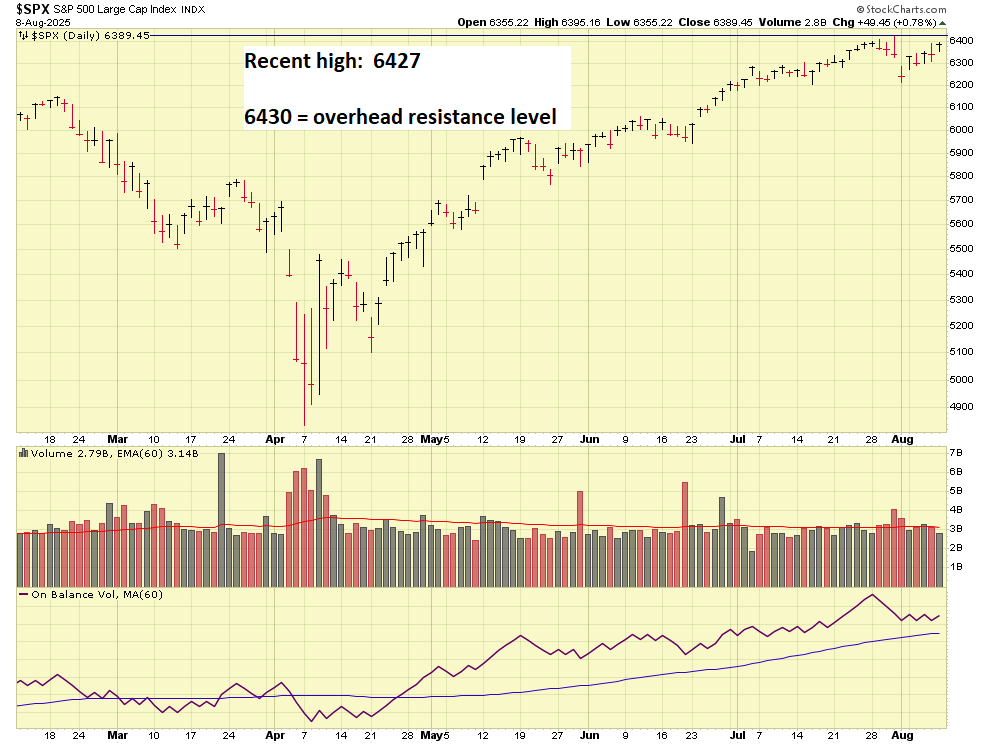
Bottom Line up Front:  I am 50% S-Fund, 50% C-Fund.  The I-Fund flashed some energy but I am not so sure I want to be in international stocks right now, tariff impact is still an “unknown” on international companies.   The S&P 500 has hit a new high, on July 31, attaining 6427.   The next level to “break through” is 6430.   

As we know, new highs are a sign of strength.   Indeed not every day has been sunshine and roses, we have seen some big down days in the market.   

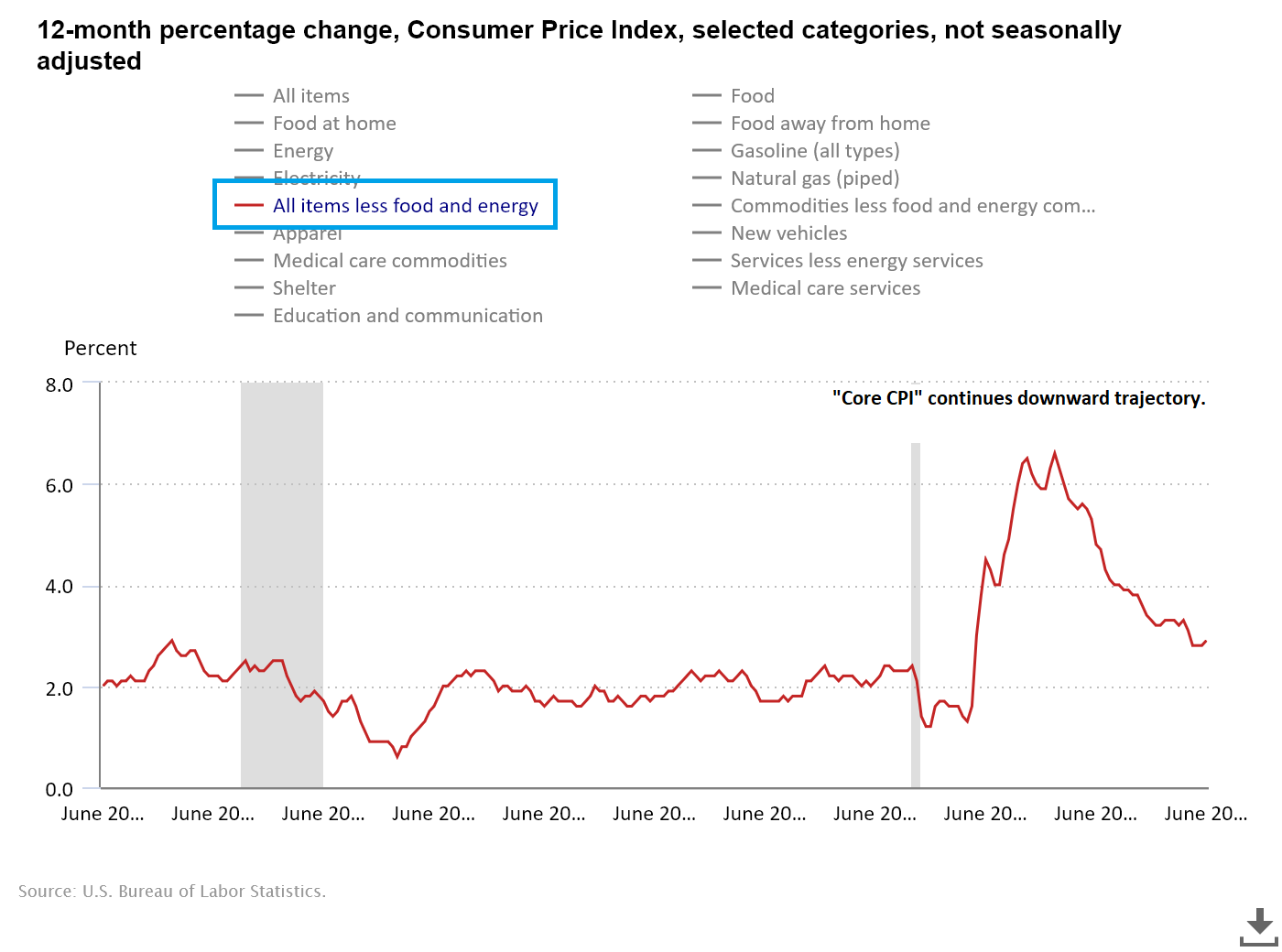
With that said, inflation data seems to indicate we are close to the FOMC desired 2% level.   Will we ever perfectly attain 2.0, as in two point zero percent, perfectly?   I don’t know.   But inflation is down-trending and some believe a rate cut is in the cards sometime this year.  See CPI Chart:

Market Highlights

  • In the week ending Friday, August 8, 2025, the S&P 500 rose about +0.8%, almost matching its recent record high. The Nasdaq jumped about +1%, making yet another all-time high.

  • It was the best weekly performance since late June for the S&P 500, and the Nasdaq surged nearly +3.9%—again breaking records.

Price action matters:

When the market pushes beyond previous highs or breaks through resistance, it often signals strength. Recently, the Nasdaq’s new peaks and the S&P 500 closing near its highest levels suggest that buying power is strong and momentum remains intact.

Watch for ‘distribution’ days:
Some days show higher volume selling from large investors even when prices don’t drop sharply. These “distribution” days can be early signs of caution. While sharp sell-offs haven’t appeared yet, it’s worth watching volume closely after rallies.


KEY MARKET STATS

  • S&P 500 weekly change: +0.8% (Week ending Aug 8, 2025)

  • Nasdaq weekly change: +3.9% (Week ending Aug 8, 2025)

  • S&P 500 status: Near record high

  • Nasdaq status: New all-time highs


Economic Outlook

Inflation data ahead

  • Tuesday, August 12, 2025: Consumer Price Index (CPI) release for July

  • Thursday, August 14, 2025: Producer Price Index (PPI) release for July

Spotlight on stagflation worries
Some economists warn about “stagflation-lite”—a period of slow growth with rising prices. The services-sector price index recently hit a high while growth slowed.

When the Fed meets next

  • Tuesday–Wednesday, September 16–17, 2025: Federal Reserve policy meeting
    The Fed left rates unchanged in July but signaled the possibility of a rate cut later this year. Markets currently expect a high probability of a cut in September.


UPCOMING ECONOMIC EVENTS…

Next two weeks will have important events and reports impacting the markets:

  • Aug 12, 2025: CPI inflation report

  • Aug 14, 2025: PPI inflation report

  • Aug 15, 2025: University of Michigan Consumer Sentiment (Preliminary August)

  • Aug 21–23, 2025: Jackson Hole Federal Reserve conference

  • Sep 16–17, 2025: Federal Reserve policy meeting


International & Small-Cap Moves

Small-to-mid-sized U.S. companies (S-Fund) have rallied strongly in the second quarter thanks to easing inflation and expectations for lower rates.

International stocks (I-Fund) are up about +11.8% year-to-date through July 31, 2025, boosted by a softer dollar and stronger economic performance in Europe, Japan, and the U.K.


YTD PERFORMANCE SNAPSHOT

  • C-Fund: Strong gains, near record levels

  • S-Fund: Solid rebound in Q2

  • I-Fund: +11.8% YTD through July 31, 2025


What’s Coming Soon

Key geopolitical and trade dates:

  • Aug 14, 2025: Scheduled expiration of U.S.–China tariff truce unless extended

  • Aug 20, 2025: Planned meeting between U.S. and Russian leaders


Federal Retirement Benefits and Pending Legislation

Proposals in Washington could impact federal retirement benefits.

Proposals underway:

  • End of annuity supplement for many FERS retirees before Social Security eligibility, except for certain special categories.

  • Change from “High-3” to “High-5” salary average for pension calculations, which would lower benefits for many.

  • New fees and audits: MSPB appeal fees and tighter verification of dependent eligibility for FEHB health benefits.

  • Legislative timeline: House passed its budget resolution on March 4, 2025. Senate negotiations are ongoing; final votes could occur in September or October 2025.


FEDERAL BENEFITS PROPOSALS AT A GLANCE

  • Annuity supplement may end for most retirees

  • “High-3” could become “High-5”

  • New MSPB appeal fees

  • Stricter FEHB dependent checks


Why it matters
These proposals could lower pension payouts or affect retirement plans, especially for those considering early retirement.


In Summary

  • C-Fund: Large U.S. companies remain strong and near record highs.

  • S-Fund: Small-to-mid caps rebounding with momentum.

  • I-Fund: Outperforming U.S. markets YTD.

  • Economy: Inflation reports on Aug 12 and Aug 14, Fed conference Aug 21–23, next Fed policy meeting Sep 16–17.

  • Federal benefits: Potential changes could impact supplements, pension formulas, and health coverage rules, with final decisions possible in fall 2025.

Again, I am 50% C-Fund and 50% S-Fund.    In the near future, keep an eye out for 6430 on the S&P 500, and potential interest rate cuts.   

Thank you for reading, please share with anyone who may benefit from this analysis…thank you !

-Bill Pritchard


Markets rebound as tariff headwinds subside


Howdy Folks

Bottom Line Up Front:   I am returning 50% S-Fund, 50% C-Fund.    Lets dig into this deeper below…

Unfortunately I am not able to upload graphics due to a server side issue with this site I am working to resolve.

The market indexes, the S&P 500 in particular, have made recent “All Time Highs” which indicates the lack of overhead resistance and an ostensibly “open road” to further gains.

Trivia but important- post US troop direct involvement on dates/ Jan 17, 1991 Operation Desert Storm, March 20, 2003 Iraq Invasion, and April 15, 1986 Libya bombing (by F-111 jets), the stock indexes all rallied.   The recent B-2 bombings of Iraq will most likely result in the same behavior.   Furthermore, tariff headwinds appear to have subsided.   Real world indicators such as travel counts, hotel rooms, consumer spending, all indicate that the economy and people in general are not being hampered by middle east tensions or inflation.   I

I feel comfortable returning to stock funds, with S-Fund and C-Fund being my choices.   The I-Fund in my opinion is a little more prone to volatility at the present time.

Thanks for reading and I apologize for the lack of charts

-Bill Pritchard


“Liberation Day” – Dow Futures crash 900 points overnight


Bottom Line Up Front:  I remain 100% G-Fund (a change made on March 6, almost a month ago).

Happy Liberation Day, or what is left of it.  “Liberation Day”, April 2, 2025 to be exact, is when President Donald Trump announced a major trade policy shift involving the implementation of sweeping “reciprocal tariffs” on U.S. imports. This policy, unveiled in a speech from the White House Rose Garden, established a 10% baseline tariff on all imported goods, with significantly higher rates applied to specific trading partners—such as 34% on China, 20% on the European Union, and up to 46% on Vietnam—effective immediately on April 3, 2025. Trump framed this as a “declaration of economic independence,” aimed at addressing perceived trade imbalances and protecting American industries, though it marked a dramatic escalation of his administration’s trade war strategy.

A brief 15 minute analysis of this tariff policy (personally, I “see where he is coming from”, but…) is that the Trump Tariffs are basically the inverse of what NAFTA was.   NAFTA, a trade agreement between Canada, US, and Mexico was actually signed by then President Bush in 1992.

Flash forward and some new thinking exists in the trade circles.   Tariffs are the new policy, however while well-intended, the markets are not liking them.

The thought process is tariffs will have an inflationary effect, which I agree they will.   When inflation goes up, interest rates go up (or don’t go down further…), and when interest rates go up, the economy is hurt.

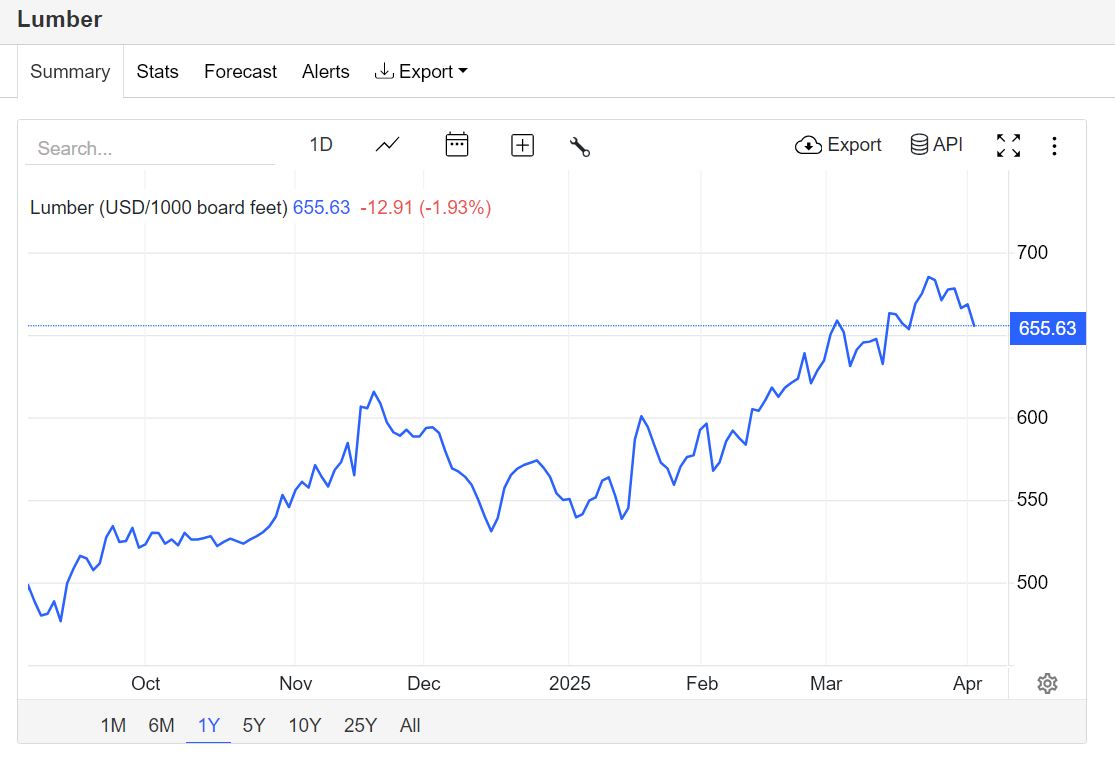
Lets look at the price of lumber, something impacted by tariffs and the cessation of imported lumber from Canada:

As we can see, lumber prices have been climbing steadily, which will have impact on the price of new home construction (which is stagnant anyway), which will trigger other costs that may be captured in CPI and PCE inflation data.

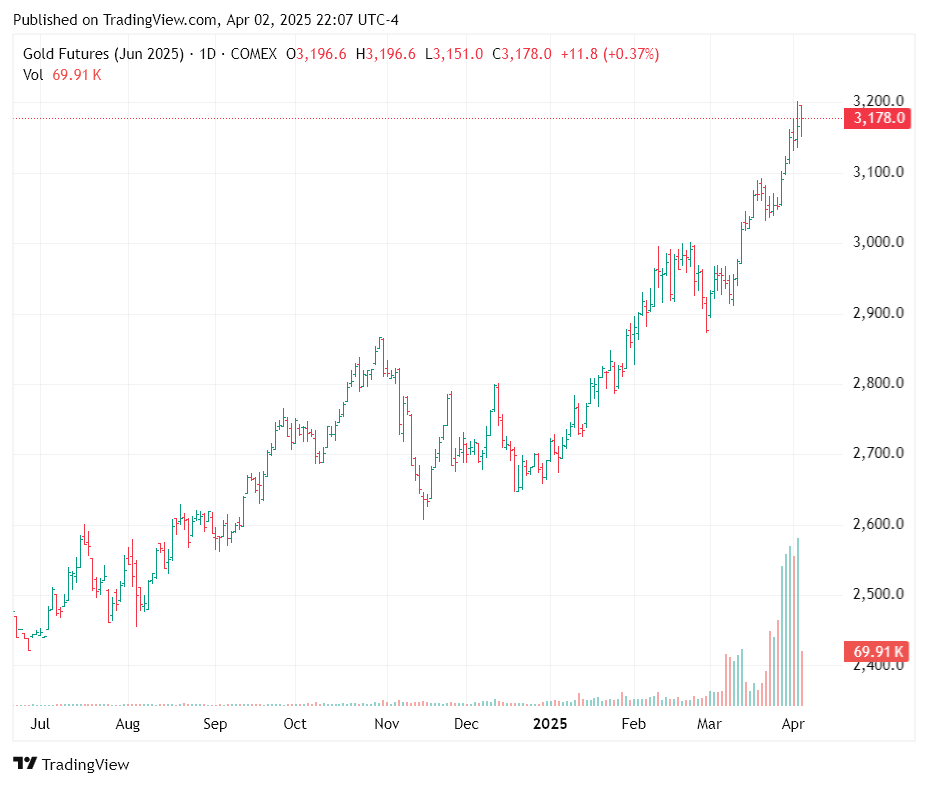
Gold, the classic, “go to” safe haven “currency”, is hitting new highs, reflective of nervousness in stock markets, chart below:

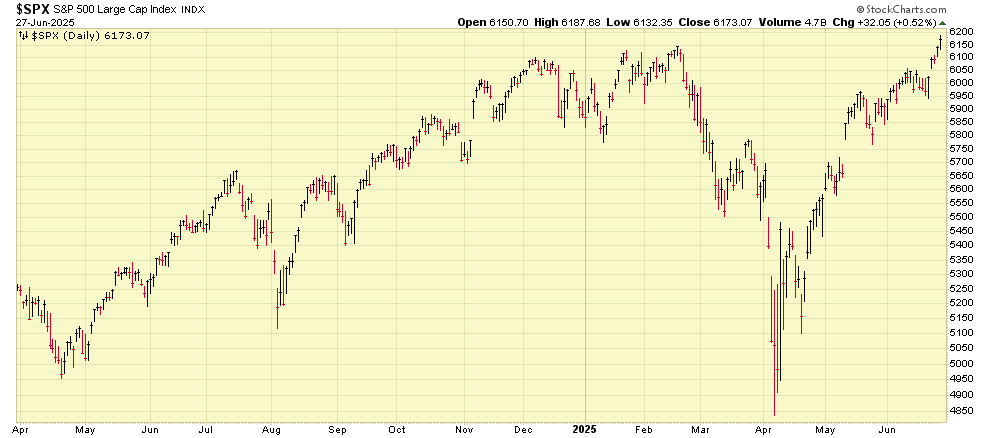
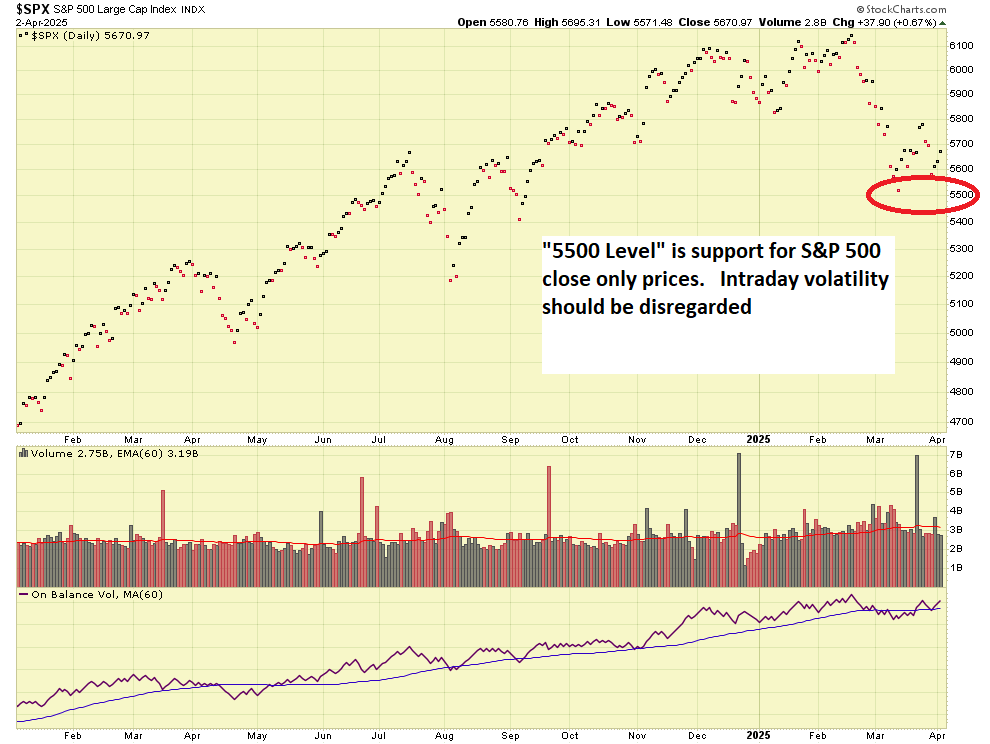
My benchmark index for stocks in the S&P 500:  Thousands of mutual funds and retirement plans are invested in it, the biggest companies themselves are part of it (Apple, Wal-Mart, Home Depot,etc), and for a variety of reasons it is my barometer for stock market health.    The “support level” to watch is a close below 5500.  This is a clear red flag against a healthy market, and continued activity below 5500 is almost a guarantee for a Bear Market to soon exist.   See chart:

With that said, what exactly is a Bear Market.  I have covered this topic many times over the years, suffice to say it is a 20% decline from a “recent” (within the last 12-24 months) high in a benchmark index.   To make it simple, if any of the below indexes hit these levels, that index itself will be considered to be in a “Bear Market”

In sum, I remain 100% G-Fund, something I moved into back during the first week of March.   Here we are, commencing April, and my earlier beliefs remain the same:  the market is not in love with the tariffs and technical indicators (chart analysis, etc) are pointing towards a continued downturn.   It is what it is.

Thanks for reading, talk to everyone soon

-Bill Pritchard


March 10 update – Indexes go Lower


As most know, the last few days have been rather brutal in the markets.   On March 6, I submitted my change request to move to 100% G-Fund, which (shockingly) took effect on March 7.    Today, March 10, the Dow Jones index closed 890 points to the downside (losing up to 1,100 points intraday).   The S&P 500 index and NASDAQ also all closed lower:

Clearly, the reasons behind this remain “Tariff Talk” and inflation concerns.  As we know, tariffs could potentially cause inflation to tick higher.   They also could potentially have a COVID-like effect (remember grocery store shelves devoid of toilet paper) on products.   If Canadian lumber is shut off, American lumber producers cannot turn on the spigot full bore overnight…this will result in a supply shortage as production (supply) may not be able to keep up with demand.   High priced housing and new home construction (lack of…) may fix this problem in this particular example (because the lumber demand is softened) but you get the point.   So does Wall Street.   And they are “speaking” with their trading activity.

On Wednesday March 12, at 8:30 PM Eastern, the “CPI” will be released.  Often discussed here, inflation (a great post from 2018 is here) is also tied to interest rates.    If inflation is rising, the Federal Reserve may be inclined to PAUSE further rate cuts at the minimum, and at the worse, RAISE interest rates.    In sum, rising inflation is not embraced by the markets.   A quick search of business news reflects that 2.9% is the expected “Headline CPI” or “CPI” reading.  This is not “Core CPI” which is CPI without fuel and food.

Should we see CPI come in at 3.0%, the market will likely go down.  It WILL go down if CPI is 3.1, 3.2% or more.    Pray that does not happen.   CPI release can be found here

With that said, I conclude this post.   Tariff and inflation concerns rule the markets, and major fund managers are not “waiting to find out” and are exiting positions.

Have a great week and thanks for reading

-Bill Pritchard


My personal TSP allocation changes to 100% G-Fund


Good Morning

Short post, I will provide a more in-depth explanation in a week or two.   Bottom Line, I am moving my TSP balance to 100% G-Fund.    The markets are NOT responding well to the tariff policies being pushed forward, and while the intent of them is correct (my opinion), the market has other ideas.   Some naysayers exist who are lambasting these policies, unfortunately we are seeing this reflected in the financial markets and retirement accounts.  I personally am not willing to roll the dice inside the casino called “Geopolitical global trade wars” as a retired guy.

Do what is correct for you, this is not investment advice.  My retired status, personal risk tolerance, higher priority on the stability and preservation of my money has resulted in this decision.   For further information on the G-Fund may be a tool for you, please see the official guidance at https://www.tsp.gov/funds-individual/g-fund/

Being in the G-Fund is not “leaving the TSP.”   The TSP is a gun vault, open the vault, and different shelves exist inside.   I am moving my stuff to the “G-Fund shelf.”

This is known as “reallocating” (indeed, the TSP site itself uses the word “Reallocation” of funds when changing funds), and there is nothing evil or “wrong” about reallocation.  Some links about this concept are below:

Click to access PAS-model-rebalancing.pdf

https://www.investopedia.com/how-to-rebalance-your-portfolio-7973806

https://www.forbes.com/sites/carriemccabe/2025/02/27/tough-markets-smart-moves-how-investors-are-reallocating-capital/

https://www.aaii.com/journal/article/why-we-dont-rebalance

Thank you for reading

-Bill Pritchard


March 1 Update – Dow rises 600 points, S-Fund weakens, and Inflation continues


Howdy Folks

Well what a crazy day February 28, 2025 was.  I will save the political commentary, but as we now know, the mineral rights deal between Zelensky and President Trump fell apart.   Market wise, then what happened?   The Dow Jones closed for the session 601 points up.   See Chart….note that media puts Zelensky leaving the location at 1:41 PM Eastern Time:

Can one conclude that the markets are “happy” about this event, or are they smarter then we all are and are happy about something else.  Time will only tell, and all we can do is trade the trend that the markets give us.   Sadly, the markets, which celebrated President Trump’s huge victory in November, have had some stumbling lately, largely due to inflation concerns.   My opinion is this deal will get done.

The S&P 500, my benchmark index, has drifted below (but gone back above), its 50-day Moving Average numerous times since December.   While not a “red flag” it falls in the category of “pay attention.”   See chart:

Recent Consumer Price Index (CPI) inflation data reveals that inflation’s downward trajectory (improvement) has flatted.   As we know, the Federal Reserves “target” inflation number is 2% (they use the PCE inflation data but its almost the same…).   In theory, as we arrive to 2%, interest rate hikes will stop.   As we do not arrive to 2%, some argument is out there that interest rate hikes will return.   So, the market is nervous about this.   Please see most recent CPI chart:

Tariffs, which, depending what time of the day you watch Bloomberg, are good one day, bad the next, and I am weary of the different academic theorists and talking heads.   In summary, if tariffs help US business, our stock market (in theory) will go up.   If damage and suffering is done, on the tariff pathway, our stock market will do down.   As the President is using tariffs as a tool in his diplomatic toolbox, some economic concerns exist.

According to the Federal Reserve Bank of Boston, an additional 25 percent tariff on goods from Canada and Mexico combined with an additional 10 percent tariff on goods from China could add as much as 0.8 percentage point to core (excluding food and energy) inflation.   Remember  my 2% comment above?   0.8 percent may not seem like a lot, but it moves the needle farther, not closer, to 2%.   Entire business school departments cannot agree on what will really happen to the stock market after tariffs, so losing sleep over this is a moot point.

That brings us to the S-Fund, which I am 100% invested in at the present time.   My “market calls” have an almost unblemished record, but strangely the I-Fund and C-Fund are outperforming the S-Fund for the last few weeks.   I will monitor the situation, but we may see the S-Fund log a month or two of negative, or poor, returns.   I am not moving anything yet, but dialing back a 100% commitment to S-Fund and instead choosing S and C, or C and I, may be something in my consideration for next month.    Just an FYI.

With that said, we conclude this update.  If the images or graphics do not appear, the direct link to this website is:  https://www.thefedtrader.com/

Thank you for reading !

-Bill Pritchard


Happy belated New Year 2025 – Dow rises 700 points on Jan 15, 2025


Happy Belated New Year 2025 everybody

As today Jan 15 2025, closes out, we now have two weeks of “market action” behind us.    My last post dated in November discussed the election and obviously we know the winner is Mr. Trump.  Politics aside, I see GOOD THINGS happening as they directly relate to the economy.    Some of which are deregulation, revised tax policy, and (all indications…) a pro-business administration.   ALL of this should propel the stock market higher.

In my October 22, 2024 post, I discussed my move the the S-Fund.   I remain committed to those reasons, and expect small cap stocks to perform well in 2025, consistent with historical patterns associated to elections.

The market does have some concerns:   Tariffs, “Trade Wars”, and of course the ongoing good news-is-bad news, such as improving inflation numbers, which of course “means” (does it?) the Federal Reserve will not lower interest rates much further.   Lets look at some charts:

As noted on the chart, is the huge “upside move” on 11/06/2024, once we had a known winner of the election.   The market likes certainty.   Then, traders went home for Thanksgiving and Christmas, and the index drifted downward, with no volume to prop it up.  Normal behavior.   We saw some “sell off” action on or about 12/18/2024, likely to exit positions before the holidays.   Normal behavior.   On 01/15/2025 (date of this post), the Dow Jones (NOT a small cap index, I know….) rose 700 points, arguably based on the fact that inflation indeed is improving.  Lets look at that, Core CPI:

As indicated, Core CPI is improving, much improved from its peak of 6.6% in September 2022.  This has allowed the market to breath a sigh of relief in regards to interest rates.

The way I see the world, the fundamental and economic “story” supports the charts, and thus I remain committed to my position in the S-Fund.   My personal TSP is 100% S-Fund, however I would be probably just as happy being 50% S-Fund and 50% C-Fund.

With that said, this concludes the first post of 2025.   As things warrant, I will post again in the upcoming weeks.   I hope everyone has a great year.   Please continue to share this website with your colleagues and friends.

Direct link to this post, if the above images do not come through your email, is at this link:  https://www.thefedtrader.com/

Thank you again

-Bill Pritchard